15 essential UX design principles every product designer should know
Great UX is rarely accidental. Product designers rely on principles that help them make consistent decisions when requirements are incomplete or stakeholders disagree.
PublishedAugust 28, 2026
CategoryProduct Design
Reading time4 min read
A practical guide to 15 UX design principles that help teams create clearer, faster, more accessible digital products—and how to treat principles as frameworks, not rigid rules.
The principles
15 principles worth applying.
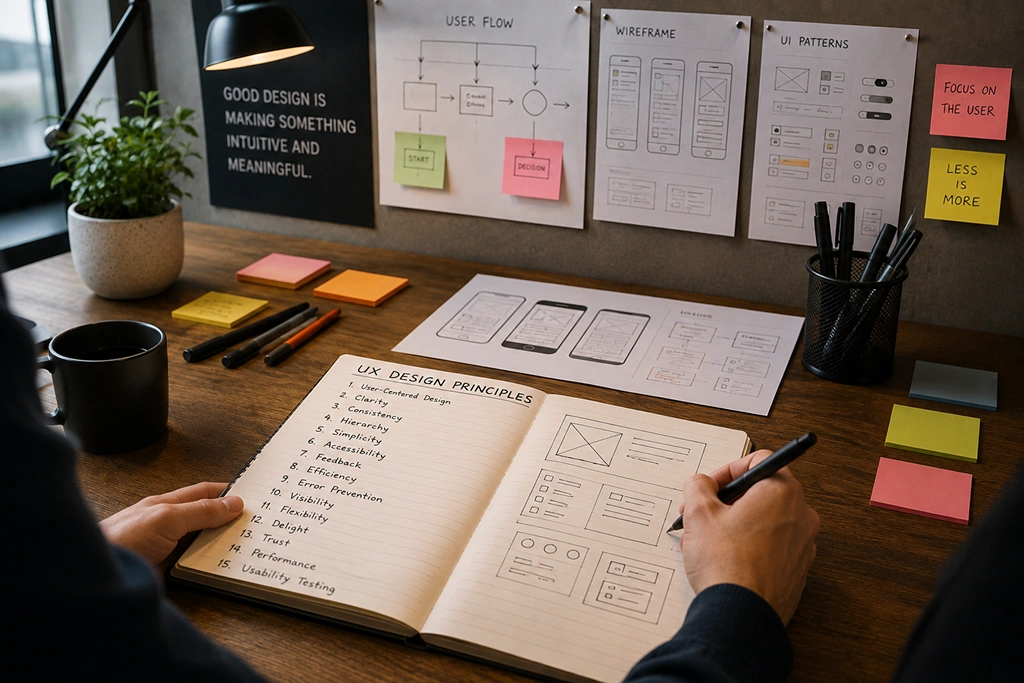
1. Design for the user goal — optimize the task users actually need to complete. 2. Keep it simple — remove unnecessary complexity. 3. Consistency matters — similar things should behave similarly. 4. Make hierarchy obvious — visual emphasis should reflect importance. 5. Give feedback — users need confirmation after meaningful actions. 6. Prevent errors — good design reduces mistakes before they happen. 7. Support recovery — when errors happen, make the path back clear. 8. Recognition beats recall — show options instead of forcing memory. 9. Use familiar patterns — familiar interactions reduce learning cost. 10. Design progressively — reveal complexity when users need it. 11. Respect accessibility — design for different abilities and contexts. 12. Use content as interface — labels and microcopy are functional components. 13. Optimize common paths — repeated workflows deserve special attention. 14. Test assumptions — design opinions should meet real user evidence. 15. Measure outcomes — good UX should connect to meaningful product metrics.
Frameworks
Principles are not rigid laws.
A design principle is a decision framework, not a rule that overrides context. For example, simplicity can conflict with flexibility. The solution is not always to remove options; it may be to use progressive disclosure. The best designers understand the trade-off and make it intentional. For SaaS and AI products, these principles become even more important because users are often working with complex information—the interface must reduce complexity without hiding important control.
In practice
How to actually apply these principles under deadline pressure.
Principles become useful only when they survive contact with a deadline, which means having a version you can apply in five minutes during a review. Group them by the moment you are in. During layout, reach for alignment, hierarchy, and consistency. During flow, reach for progressive disclosure and clear calls to action. During error handling, reach for specificity and recoverability. Before shipping, check the accessibility and state coverage principles. Two habits carry most of the value. First, fix hierarchy first, because most interface problems are really questions of what should be read first and the answer is usually already in the content. If a user cannot tell what the page is asking of them in three seconds, styling will not rescue it. Second, test the unhappy states, because those are where most real usability problems live. Empty, loading, error, permission-denied, and partial-failure states are each visited far less often than the happy path, so they rarely get reviewed, and users hit them at exactly the moments they are least patient. Finally, keep a short written rationale next to key decisions. Six months later the reasoning behind a constraint is the only thing preventing a well-meaning redesign from breaking an intentional behavior.
Measurement
Measuring whether a design change actually helped.
Most design work is judged by opinion in a meeting, which is unreliable in both directions. Three approaches give you something better. Usability testing with five people reliably surfaces most of the severe usability problems, because five people encounter nearly every major obstacle in a task flow. It tells you where people hesitate, not whether they are satisfied, so treat it as a diagnostic rather than a score. Behavioral analytics shows what people do rather than what they say. Funnel drop-off locates the step where users leave, and changes in drop-off after a release are far more persuasive than internal preference. The limitation is that analytics shows behavior, so it cannot tell you why, and it under-represents the users who left without ever starting. A structured question such as the System Usability Scale or a single-question equivalent gives you a trend you can track over time. Treat small movements as noise and look for meaningful shifts. Combine them. Testing finds problems, analytics shows whether fixing them mattered, and a survey tracks perceived effort over time. Any one alone leaves a gap, and the combination is what lets a team argue about evidence rather than taste.
“A design principle is a decision framework, not a rule that overrides context.”
Design review checklist
- ✓Is the page optimized around the user's core task?
- ✓Is unnecessary complexity removed?
- ✓Do similar elements behave consistently?
- ✓Is hierarchy aligned with importance?
- ✓Do meaningful actions get clear feedback?
- ✓Can users recover easily from errors?
- ✓Are recognition and familiar patterns preferred over recall?
- ✓Is complexity revealed progressively?
- ✓Are accessibility and microcopy treated as functional?
01
Start from the goal.
Optimize the task users need to complete, not the feature list.
02
Trade-offs are intentional.
Simplicity and flexibility conflict; progressive disclosure resolves the tension.
03
Measure the outcome.
Good UX connects to meaningful product metrics, not just preference.
Written by

Vordx TeamAI & Software Engineering Team
The Vordx Technologies engineering team builds AI systems, web platforms, and digital products for startups and enterprises. We write about the architecture, cost, and delivery decisions that determine whether a software project actually ships, drawing on production work across AI development, backend systems, and product design.
Need this applied to your product?
Let Vordx review your UX, website, or product flow and identify the highest-impact trust gaps.
Start a projectRead next
More field notes from the Vordx studio.



Build with Vordx
Ready to create a digital product that feels impossible to ignore?
Bring us the idea, product, workflow, or brand moment. We will shape it into a premium experience built to launch, scale, and convert.
contact@vordx.com