How much does it cost to build a SaaS product in 2026?
SaaS products are more expensive than simple websites because they are ongoing software businesses—with authentication, billing, data models, dashboards, integrations, monitoring, and a product experience that must evolve.
PublishedAugust 26, 2026
CategorySoftware Development
Reading time3 min read
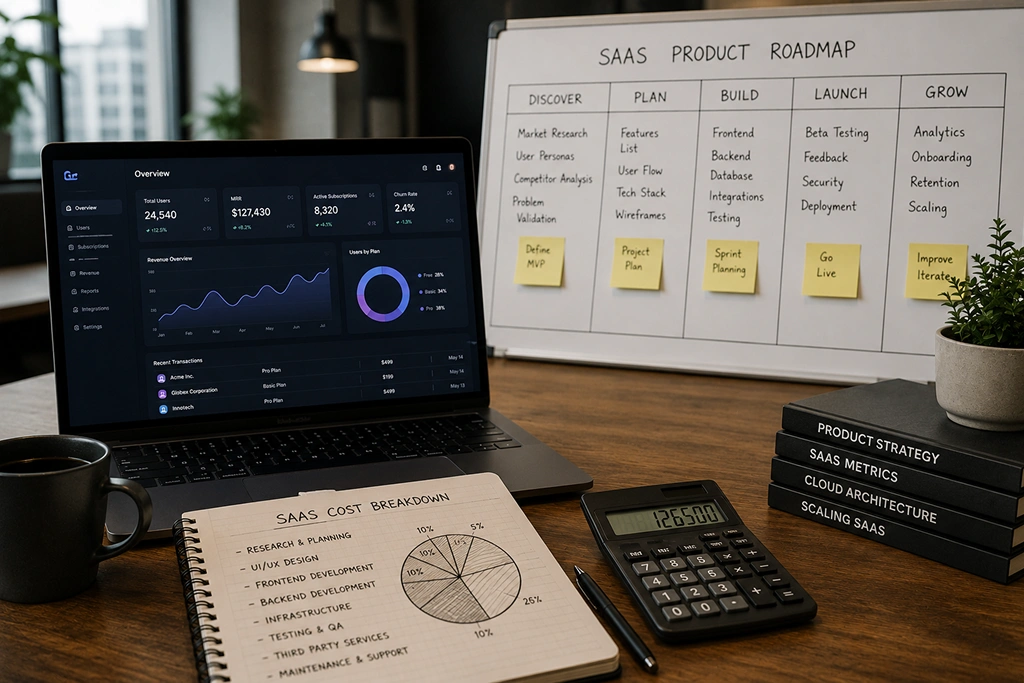
Learn what determines SaaS development cost in 2026, including product design, architecture, multi-tenancy, subscriptions, integrations, security, and the costs that continue after launch.
Planning ranges
A practical 2026 planning range.
SaaS products are more expensive than simple websites because they are ongoing software businesses. They need authentication, accounts, permissions, billing, data models, dashboards, administration, integrations, monitoring, and a product experience that can evolve over time. • Focused SaaS MVP: $30,000–$70,000 • Mid-complexity SaaS: $70,000–$150,000 • Complex B2B SaaS: $150,000–$300,000+ • Enterprise SaaS platform: $300,000+ depending on requirements
Where the money goes
Where the budget is spent.
Product discovery and UX determine what should be built. UI design turns the architecture into an understandable experience. Engineering creates the application, APIs, database, authentication, billing, and integrations. QA protects reliability. DevOps and cloud infrastructure support production. Multi-tenancy is a major architectural decision. If multiple organizations use the platform, tenant isolation, permissions, billing, reporting, and data access need to be designed correctly from the beginning.
After launch
SaaS costs do not end at launch.
You should budget for hosting, observability, support, security updates, product improvements, third-party APIs, email and SMS, payment processing, and potentially AI inference. A better SaaS roadmap starts with the smallest workflow that proves the business model, and builds a production-quality core rather than a huge collection of shallow features.
Cost drivers
What determines the cost of a SaaS product.
SaaS estimates are driven by four things, and quoting one without the others is how projects land 40 percent over. Scope of surface area is the first. Authentication, billing, roles and permissions, admin tooling, notifications, audit logs, and reporting are rarely in the original brief but are what a customer asks for in month two. They are not exotic features; they are the difference between a demo and a product, and they are usually a large share of the work. Multi-tenancy and data isolation are the second. A single-tenant internal tool is dramatically cheaper than a multi-tenant product with per-customer isolation, and retrofitting isolation after launch is one of the most expensive corrections available in software. Third is integration count. Each third-party API adds its own authentication, rate limits, failure modes, and a periodic upgrade when that provider changes something. Fourth is the compliance and reliability bar. Enterprise buyers ask about uptime, backups, data residency, and audit trails. Meeting those expectations is real engineering, and it is safer to plan for it than to be asked for it by a customer mid-sales-cycle.
Phasing
Spending in phases instead of one large build.
The most reliable way to control SaaS budget is to stop treating the build as a single event. Most products can ship a paid version in phases, and each phase funds the confidence needed for the next. Phase one is deliberately narrow. Pick the single workflow that a customer would pay for on day one, build it end to end including billing, and put it in front of a small number of real users. This is the phase where you learn whether the problem is worth solving, and it is far cheaper to learn that before building the platform. Phase two hardens what worked. This is where reliability, permissions, audit logging, and the second and third integrations appear, and it is usually the phase buyers start caring about. Phase three builds the platform: shared onboarding, self-serve flows, and the multi-tenancy model that lets you serve many customers without manual work per account. This sequencing also protects the estimate. Requirements discovered in phase one are cheap to incorporate, while the same requirements arriving after a broad initial build usually mean rework across everything already written. The total is frequently lower, and what you learn in the first weeks is worth more than the calendar time saved.
“Launch with a system that can learn from real users and expand without a complete rewrite.”
SaaS budget checklist
- ✓Is multi-tenancy designed correctly from the start?
- ✓Are authentication, billing, and permissions scoped realistically?
- ✓Is the MVP a single workflow that proves the business model?
- ✓Are hosting, observability, and support in the ongoing budget?
- ✓Have third-party API and payment costs been modeled?
- ✓Can the architecture expand without a rewrite?
01
SaaS is a business, not a website.
Auth, billing, multi-tenancy, and monitoring make it inherently more complex and costly.
02
Design multi-tenancy early.
Tenant isolation, permissions, and reporting must be correct from the first day.
03
Plan beyond launch.
Hosting, support, and improvement costs continue long after the MVP ships.
Written by

Vordx TeamAI & Software Engineering Team
The Vordx Technologies engineering team builds AI systems, web platforms, and digital products for startups and enterprises. We write about the architecture, cost, and delivery decisions that determine whether a software project actually ships, drawing on production work across AI development, backend systems, and product design.
Need this applied to your product?
Let Vordx review your UX, website, or product flow and identify the highest-impact trust gaps.
Start a projectRead next
More field notes from the Vordx studio.


Build with Vordx
Ready to create a digital product that feels impossible to ignore?
Bring us the idea, product, workflow, or brand moment. We will shape it into a premium experience built to launch, scale, and convert.
contact@vordx.com