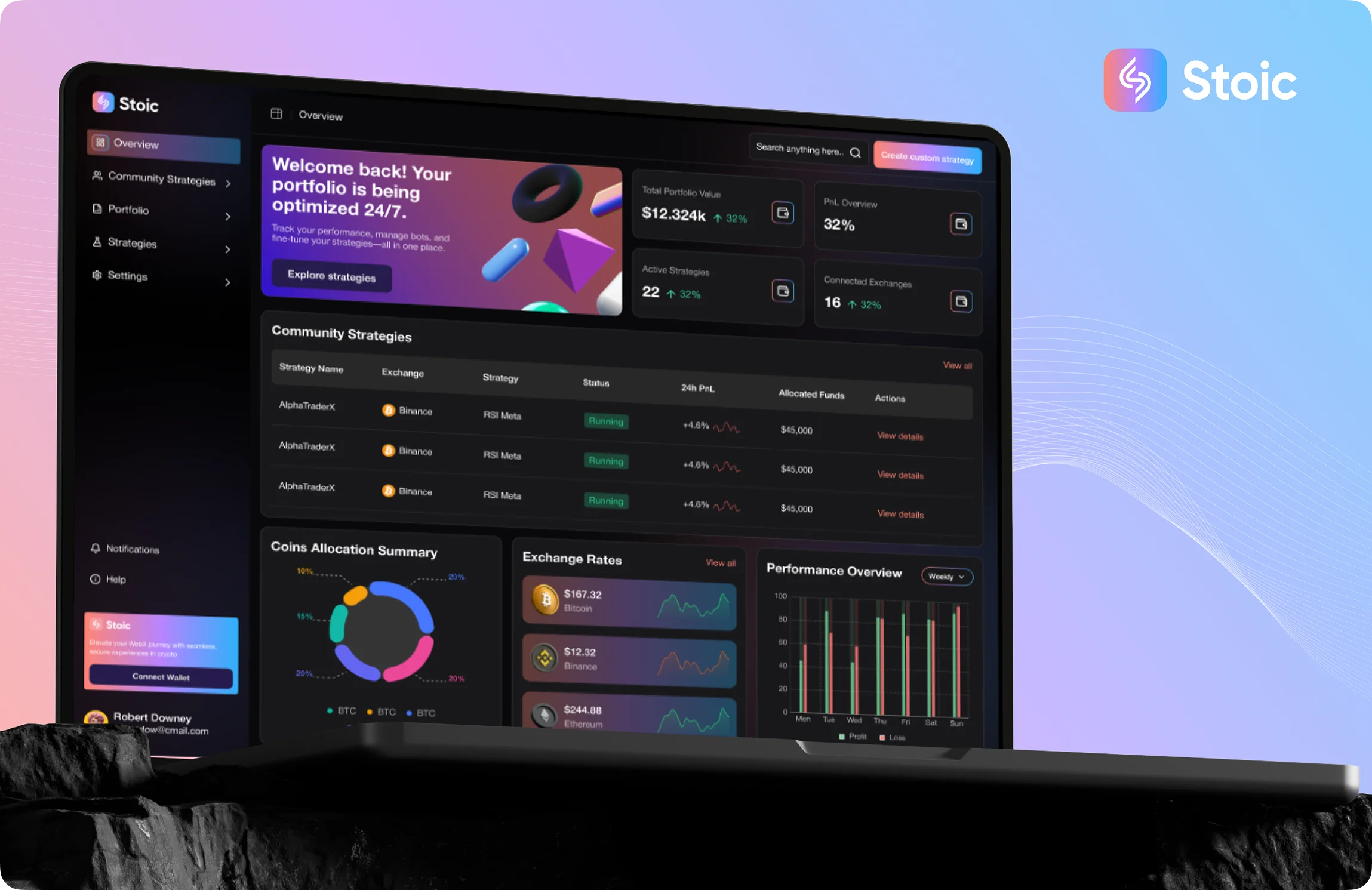
Idea validation
Assess market fit, user demand, and technical feasibility before committing to build.
MVP Design and Development
We help shape, design, and build MVPs that validate the core idea quickly without making the product feel unfinished.
What we do
Outcomes
Faster time to market.
A credible launch experience.
Clearer product direction.
Comprehensive MVP development services
Each engagement is shaped around the business model, user journey, technical needs, and the conversion moments that matter most.
Assess market fit, user demand, and technical feasibility before committing to build.
Define the essential feature set that delivers core value without unnecessary complexity.
Build clickable prototypes to test flows, gather feedback, and align stakeholders quickly.
Develop the functional product with clean UI, responsive front end, and stable back end.
Test with early users, collect insights, and refine the experience before full launch.
Plan the post-launch roadmap, prioritize improvements, and scale based on real usage data.
How we build an MVP
An MVP is a decision tool, not a small product. We define what it has to prove, cut everything that does not serve that proof, and put a launch date on it.
Define the assumption being tested and the number that tells you whether it worked. Without this, an MVP becomes an unfinished product.
Agree the exact feature set and what is explicitly out of scope. The out-of-scope list is the most important document in the engagement.
Design only the flows the hypothesis depends on, at production quality. A beautiful wrong MVP is still wrong.
Build front end, back end, data, and auth end to end for that slice — a real system, not a clickable prototype.
Release, instrument the success metric, and review the data together before deciding what to build, change, or stop.
Who we build MVPs for
These are the sectors where a cheap, focused first version genuinely answers the question that matters.
Success stories
Products that started as a scoped MVP and grew from there.
MVP stack
Nothing exotic. The goal is a system your team can extend after launch without a rewrite.
Delivery model
You get a working, instrumented product with the technical foundation to build on — not a prototype that has to be thrown away.
Hypothesis — Define what the MVP must prove, and how you will know
View related work
Useful reads
Cost benchmarks and process notes for founders who want to ship rather than plan indefinitely.
A focused SaaS MVP typically runs $30,000–$70,000 and ships in 6–12 weeks. An AI-enabled MVP sits at $15,000–$40,000. Simpler web MVPs land lower. The number that drives the estimate is how many workflows and integrations are genuinely required to test your hypothesis.
Usually admin depth, multi-tenancy, advanced reporting, edge-case error states, and anything that only matters at scale. We put those in writing before build starts so there is no ambiguity about what you are getting — and so the same list can be scheduled next.
That is the point of it. Because the architecture is built for extension rather than throwaway, pivoting usually means extending what exists rather than starting again. We keep the codebase yours throughout.
Yes. We regularly take over development from an internal or freelance design team, or take design in-house while your engineers build. We can also supply designers and engineers as one joined-up team.
Build the first version
Bring us the idea, product, workflow, or brand moment. We will shape it into a premium experience built to launch, scale, and convert.
Start MVP brief